
Implementation-focused articles on building software that scales cleanly.
Algolia vs Elasticsearch vs Meilisearch for Ecommerce Search
A shopper types “wireles hedphons” into your search bar. What comes back in the next 20 milliseconds decides whether they buy or bounce. That single moment is why the Algolia vs Elasticsearch vs Meilisearch decision matters more than most teams treat it. Pick the wrong ecommerce search engine and you either overpay for capacity you never use, or you ship a search box that misreads half your traffic and quietly leaks revenue.
We build and maintain search on Shopify, WooCommerce, and custom SaaS stacks, so we have shipped all three of these engines into production. None of them is “the best.” Each one wins a different argument. This breakdown is the honest version of the conversation we have with clients before a single line of integration code gets written.
What’s actually different about Algolia, Elasticsearch, and Meilisearch?
The core split is hosting model and intended job. Algolia is a fully hosted search-as-a-service that you never run yourself. Elasticsearch is a general-purpose search and analytics engine you deploy and operate. Meilisearch sits in the middle: open-source software you can self-host for free, with an optional managed cloud.
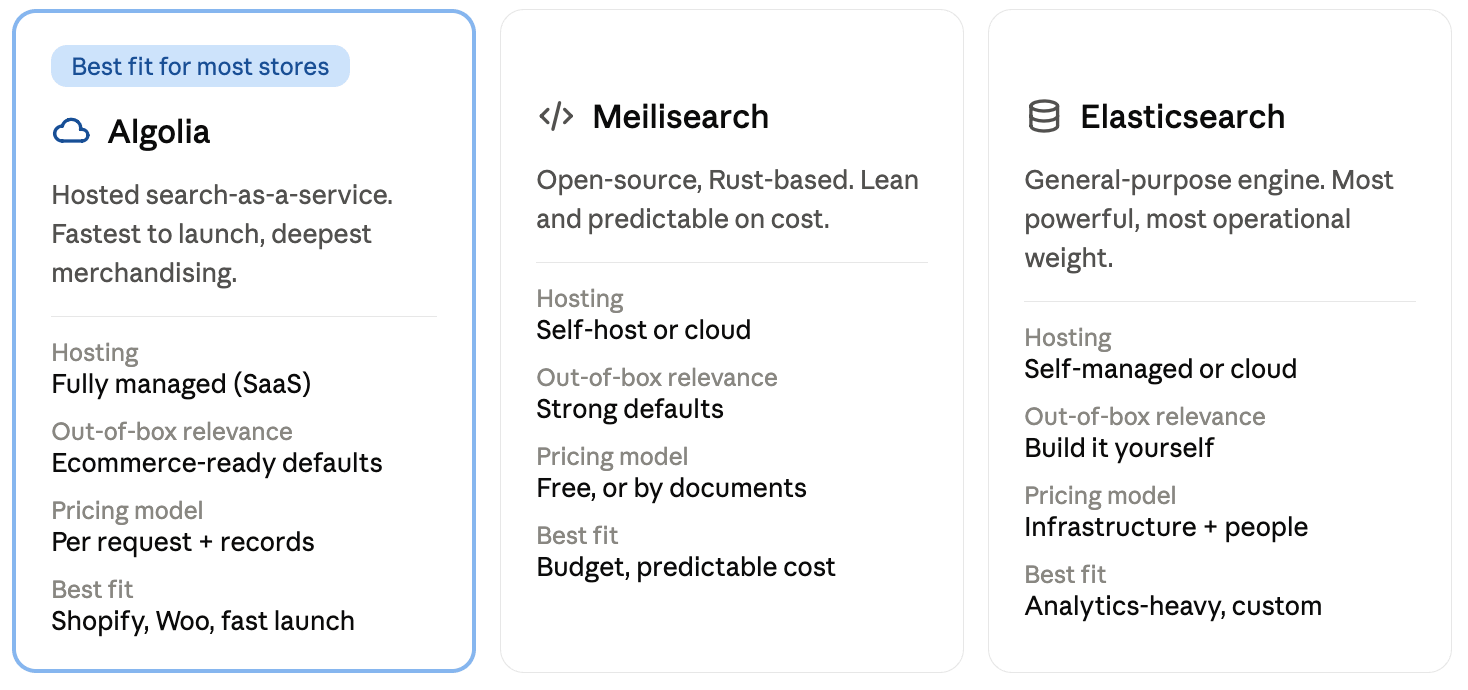
Algolia is the turnkey option. You push records to their API, configure the index from a dashboard or code, drop in their InstantSearch UI library, and you have typo-tolerant, faceted, sub-20ms search live in days. No servers. No cluster tuning. You pay a premium for that convenience, and the resulting bill scales proportionally with query volume rather than with catalog size.
Elasticsearch is the heavyweight. Built on Apache Lucene, it powers everything from log analytics at petabyte scale to product catalogs. It accommodates almost any retrieval requirement you specify, including the complex aggregations and analytical queries that neither Algolia nor Meilisearch handles competently. The catch is operational weight. A real production cluster usually runs three to six nodes, each needing somewhere between 4GB and 16GB of RAM, and someone on your team has to own it.
Meilisearch is the lean challenger. Written in Rust, MIT-licensed, and built around developer experience, it delivers sub-50ms search with typo tolerance, faceting, and geo-search out of the box. It has crossed 47,000 GitHub stars and powers search for names like Hugging Face and Louis Vuitton. You can deploy it on a modest single server, and one developer can administer the instance alongside unrelated responsibilities.
One licensing note worth knowing. Elasticsearch returned to open source in September 2024 when Elastic added the AGPLv3 option alongside its existing licenses, a shift you can read straight from Elastic’s own announcement of the open source license change. For most store owners that is trivia. For a SaaS company planning to offer search as part of a hosted product, the AGPL copyleft terms are the kind of detail your legal team will want to look at.
How does each search engine handle ecommerce relevance out of the box?
Relevance is where the Algolia vs Elasticsearch vs Meilisearch comparison stops being about infrastructure and starts being about revenue. Ecommerce search relevance means surfacing the product a shopper wants when they misspell it, search by attribute instead of name, or type two words that match 400 SKUs.
Algolia is tuned for exactly this. Typo tolerance, synonym handling, configurable attribute weighting, and custom business ranking ship as defaults you configure rather than build. Its custom ranking is the feature that earns its keep on large catalogs: when two products tie on text relevance, you decide which wins. Push in-stock above out-of-stock. Float high-margin items up. Pin a specific product to position one for a campaign query. That conditional logic is the distinction between a basic search box and a genuine merchandising instrument.
Meilisearch is surprisingly close on the basics. Its default relevance rules are good, typo tolerance works without configuration, and it now ships AI-powered hybrid search that blends keyword matching with vector search. For a store with a clean catalog and straightforward requirements, Meilisearch approaches Algolia-grade results at a fraction of the expenditure. Where it concedes ground is the sophisticated merchandising layer and the comparative maturity of the analytics surrounding it.
Elasticsearch is the most powerful and the least turnkey. Out of the box, it does not behave like an ecommerce search engine. Its Query DSL is a precise instrument, and you can build extraordinary relevance with it, but you are building it. Typo tolerance, faceting, ranking rules, synonym sets: all configurable, none automatic in the way Algolia ships them. That power is a benefit when your data model is unconventional and a liability when all you required was competent product search.
Here is the blunt version. If your catalog is standard ecommerce and you want strong relevance fast, Algolia and Meilisearch both get you there quickly. Elasticsearch rewards teams who need to bend the engine to a non-standard problem and have the engineering hours to do it.
What does each one cost at ecommerce scale?
Cost is where teams encounter the most unpleasant surprises, so examine the actual figures rather than the marketing positioning.
Algolia bills on a dual-metric model: search requests and records. Its free Build tier covers around 10,000 search requests a month. The self-serve Grow tier runs roughly $0.50 per 1,000 additional search requests and about $0.40 per 1,000 records. Grow Plus, which unlocks the AI features, charges a notably higher rate near $1.75 per 1,000 requests. Enterprise tiers like Elevate are custom annual contracts, with one industry source pegging the entry point around $50,000 per year.
The trap is search-as-you-type. Algolia fires a new request on every keystroke, so a single shopper typing “headphones” can generate ten requests before they finish the word. A mid-sized store handling 500,000 monthly searches and 250,000 records on the Grow plan would pay roughly $245 a month in overages alone. That number climbs with your traffic, not your revenue, which is exactly why fast-growing stores eventually shop around.
Meilisearch flips the math. Self-hosting is genuinely free under the MIT license, with no feature gating. Meilisearch Cloud’s Build plan starts around $30 a month, and the Pro tier lands somewhere between $200 and $300 a month for roughly 1 million documents and 10 million searches. For a high-traffic store, document-based pricing is far more predictable than Algolia’s per-request meter. The cost you trade for that is either DevOps time on the self-hosted path or a step up in plan tiers as you grow.
Elasticsearch pricing depends entirely on how you run it. Self-managed and you pay for infrastructure and the engineers to run it. Elastic Cloud prices on total RAM, and serverless options exist for variable workloads. There is no clean per-search number because the cost lives in nodes and people. For a team already running Elasticsearch for other reasons, adding product search is nearly free. For a store standing it up from scratch, the total cost of ownership is the highest of the three once you count the operational overhead.
A quick way to frame the spend across the three:
- Algolia. Lowest upfront effort, fastest to launch, but cost rises with query volume and the per-keystroke request model can produce bills that outpace catalog size. Best when traffic is predictable and engineering time is scarce.
- Meilisearch. Lowest software cost, especially self-hosted, with predictable document-based cloud pricing. Best when you have some technical capacity and want to avoid usage-based surprises.
- Elasticsearch. Cost concentrated in infrastructure and people, not licenses. Best when you already run it, or genuinely need its analytical depth.
Which search engine fits Shopify, WooCommerce, and SaaS?
The appropriate answer shifts depending on your platform, and this is precisely the consideration most generic comparisons omit.
For Shopify, Algolia is the natural fit. Shopify’s native search matches on product title and tags with no typo tolerance and no attribute weighting, which is thin for any store with attribute-rich products. Algolia replaces it cleanly through a storefront integration or a headless Hydrogen build, with webhook-driven sync that updates the index within seconds of a price or inventory change. The InstantSearch libraries slot into a Shopify theme without a custom UI rebuild from zero.
For WooCommerce, the decision is similar but the implementation matters more. The off-the-shelf community connectors tend to miss variation data, ACF fields, and custom taxonomy. We build WooCommerce search as a custom plugin around the actual field structure, and Algolia’s mature WordPress tooling makes it the lower-friction choice for most stores. Meilisearch is viable here too if cost is the priority and the catalog is clean, though it lacks a first-party InstantSearch adapter, so the UI layer needs a community adapter or a custom build.
For SaaS applications, the calculus opens up. If you need search across multiple record types scoped per tenant, all three can do it, and the choice often comes down to whether search is incidental or central to your product. Algolia’s multi-index search and tenant filtering get you there fastest. Meilisearch is a strong fit when you want to own the engine and keep costs flat as you scale. Elasticsearch earns its place when search sits next to heavy analytics, audit-log querying, or aggregations that the other two were never designed to run.
If Algolia is where you land, our Algolia integration service for Shopify, WooCommerce, and SaaS platforms covers the full scope, from index architecture through the sync pipeline that keeps records current.
When should you pick Elasticsearch or Meilisearch over Algolia?
Plenty of times, and we will tell a client so before taking the work. Algolia is the default we reach for on standard ecommerce, but it is not the universal answer.
Choose Meilisearch when budget is the hard constraint and you have the technical capacity to self-host, or when you want predictable pricing that does not balloon with traffic. It gives you a large share of Algolia’s search quality without the per-request meter. The honest caveats: it is a younger product with fewer enterprise case studies, indexing very large datasets runs slower than Elasticsearch, and analytics retention on the cloud tiers is short.
Choose Elasticsearch when search is only part of the job. If you also need log analytics, complex aggregations, full-text search across massive document stores, or vector search wired into a broader data platform, Elasticsearch is built for that breadth and the other two are not. The price of admission is operational expertise. You are running a cluster, and that needs an owner.
Choose Algolia when speed to launch, low maintenance, and deep merchandising control matter more than the monthly invoice. For a store that wants strong product search live in days, with custom ranking, A/B testing, and analytics included, it is the shortest path. The thing to watch is cost at scale, which is a planning problem, not a dealbreaker, as long as you size the plan correctly during scoping.
There is no universally correct pick in the Algolia vs Elasticsearch vs Meilisearch debate. There is only the right pick for your catalog size, traffic shape, team, and budget.
So which ecommerce search engine is right for you?
Start with one question: is search core to your product, or is it a feature you need to work well and then forget about? If it is core and analytical, lean Elasticsearch. If it is a feature and budget is tight, lean Meilisearch. If it is a feature and you want it excellent without running infrastructure, lean Algolia.
For the majority of Shopify and WooCommerce stores we work with, that last bucket is where they land. They want typo-tolerant, faceted, custom-ranked search that converts, and they do not want to staff a search team to get it. That is the case Algolia was built to win.
The mistake we see most often is choosing the engine before testing relevance against real data. Any of these three can look great in a demo. What separates a good integration from a disappointing one is index architecture designed from your actual data model, then relevance tested against your real queries before the UI gets built.
If you are weighing these options for your store or SaaS product, tell us about your search problem and we will give you a direct technical answer on which engine fits, not a sales pitch. If Algolia is the right call, we will scope the integration. If it is not, we will say so.
Frequently asked questions
Is Algolia better than Elasticsearch for ecommerce search? For most conventional ecommerce catalogs, Algolia deploys faster and provides ecommerce relevance capabilities as configurable defaults, whereas Elasticsearch requires your engineering team to implement those capabilities manually. Elasticsearch prevails when your requirements also encompass complex analytics or aggregations alongside conventional product search. The appropriate selection depends on whether search constitutes your sole requirement or merely one component among several.
Is Meilisearch a real alternative to Algolia? Yes, for many stores. Meilisearch delivers a substantial proportion of Algolia’s search quality, providing typo tolerance and faceting immediately, at considerably lower cost, particularly when self-hosted. It concedes ground on sophisticated merchandising, analytics retention, and first-party interface tooling, so suitability depends on how demanding your relevance and reporting requirements become.
Why not just use Shopify or WooCommerce native search? Native search on both platforms matches against limited fields, lacks typo tolerance, and provides no meaningful attribute weighting or configurable custom ranking. For stores where customers search by feature, dimension, or material rather than exact product name, the resulting gap in search conversion is measurable, which is the entire justification for migrating to a dedicated ecommerce search engine.
How quickly do search results update when a product changes? With a webhook-driven synchronization pipeline, index records update within seconds of a change in your platform. Shopify webhooks fire on product create, update, and delete events, and WooCommerce integrations hook into post-save and stock-status transitions, so price and inventory modifications propagate almost immediately.
Author: Neha Jain
Neha Jain is a software engineer focused on payments and API-driven integrations, including webhooks, authentication, error handling, and secure deployment patterns. Her work emphasizes production-ready implementations, with attention to vendor specifications, common failure modes, and integration reliability. She brings a practical approach to system design, balancing performance, security, and maintainability. Neha’s focus is on helping teams implement complex technical workflows with clarity and fewer regressions.
Related Posts
- Top 5 SEO Audit Apps for 2026 (And Why Local Crawlers are Winning)
- How to Migrate From WooCommerce to Shopify: A Step-by-Step Guide
- Shopify vs WooCommerce for Small Businesses: Which Costs Less to Run?
- What Counts as Valid Consent Under DPDPA, and How to Implement It in WooCommerce
- Top 10 WordPress Plugins to Supercharge Your WooCommerce Store
- How Much Does It Cost to Build a Shopify App in 2026?
