
Custom API Development and Microservices Integration Services.
We design and develop REST APIs, GraphQL APIs, and microservices architectures for new products and existing systems. Whether you need a greenfield API layer, a third-party integration, or a monolith broken into independent services, we build it production-ready and documented from day one.
APIs built for real systems, not just proof-of-concepts.
We work at two levels. We build APIs from scratch for new products that need a clean, documented interface from day one. And we integrate third-party APIs into your existing system when you need to connect your platform to external services, payment gateways, ERP systems, logistics providers, or communication tools.
Every API we build ships with an OpenAPI specification, authentication and rate limiting configured, versioning strategy in place, and a test suite covering happy paths and failure cases. APIs that are not documented and not tested are not production-ready, regardless of whether they work in development.
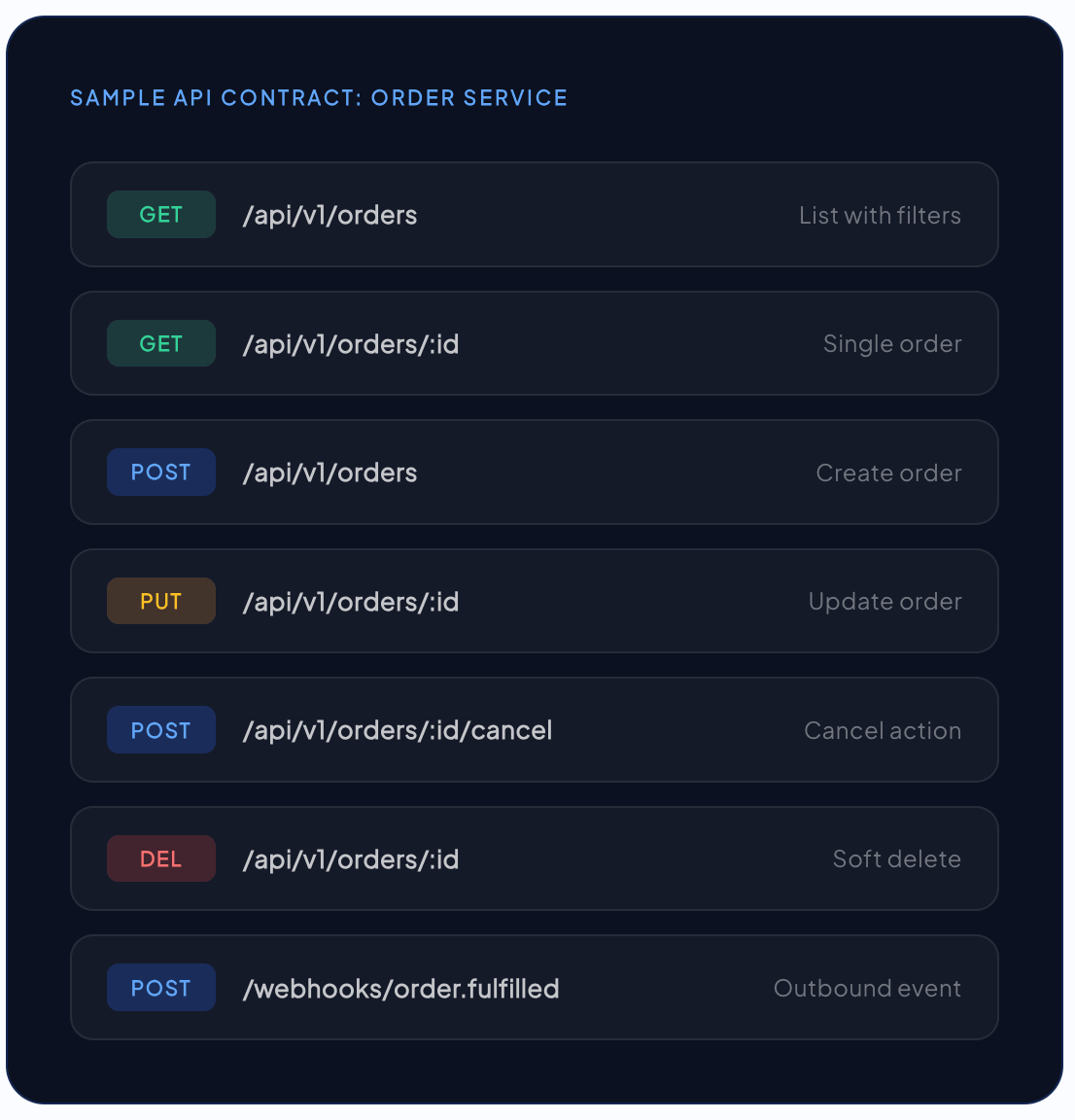
Six API and microservices capabilities we deliver.
Each is scoped individually. A single integration engagement and a full microservices architecture decomposition are very different in effort and risk profile, and we scope them honestly.
REST API Development
Clean, consistent REST APIs following HTTP conventions with proper status codes, predictable URL structures, and versioning strategy. OpenAPI 3.0 specification generated from code. Authentication with JWT or API keys. Rate limiting and quota enforcement configured from day one.
GraphQL API Development
Schema-first GraphQL APIs for products where flexible querying reduces over-fetching and simplifies mobile client data requirements. Resolvers, DataLoader patterns for N+1 prevention, subscriptions for real-time data, and persisted queries for production performance.
Microservices Architecture
Decompose a monolith into independently deployable services or design a microservices system from scratch. Service boundary definition, inter-service communication patterns (sync REST, async messaging), service discovery, circuit breakers, and distributed tracing configured throughout.
Third-party API Integration
Integrate external APIs into your existing system with proper error handling, retry logic with exponential backoff, idempotency keys, webhook processing, and monitoring. Payment gateways, CRM, ERP, logistics, communication, and authentication providers integrated cleanly into your codebase.
Webhook and Event Systems
Outbound webhook delivery systems for your platform with retry queues, delivery logs, signature verification, and consumer management UI. Event-driven patterns using message queues (RabbitMQ, SQS, Kafka) for async communication between services or between your system and external consumers.
API Security and Gateway
OAuth 2.0 and JWT authentication, API key management, rate limiting per consumer tier, IP allowlisting, and request validation middleware. API gateway setup with AWS API Gateway, Kong, or NGINX. OWASP API Security Top 10 coverage reviewed and addressed during build.
Everything your platform connects to.
We build and integrate APIs across every major business system category. Your core platform sits at the centre. Everything else connects to it through clean, documented, maintainable API layers.
APIs created and integrated across every platform we work with.
We build APIs into new systems and integrate external APIs into existing ones. Both directions, across all platforms we work with.
Shopify API Integrations
WooCommerce REST API Integrations
SaaS Platform API Layer
Mobile App Backend APIs
Bespoke System Integrations
Monolith to Microservices
REST, GraphQL, or gRPC: which is right for your system?
The protocol choice depends on your consumers, your data access patterns, and your team's skills. We give you an honest recommendation during scoping rather than defaulting to whichever is fashionable.
Widely understood, broadly supported
HTTP-based, cacheable, stateless, and consumable by virtually any client. REST is the right default for public APIs, eCommerce integrations, and systems where third-party consumers need to integrate without specialised tooling. Straightforward to document with OpenAPI and easy to test.
Best for: Public APIs, third-party integrations, eCommerce, payment gateways, and any context where simplicity and broad compatibility matter more than query flexibility.
Flexible querying, fewer round trips
Clients request exactly the data they need, reducing over-fetching and under-fetching. Ideal when multiple client types (web, mobile, desktop) need different data shapes from the same backend. Strong tooling ecosystem and excellent for product APIs consumed by your own frontend teams.
Best for: SaaS products with complex data relationships, mobile apps needing efficient data access, and teams where frontend and backend develop independently.
High performance, strongly typed contracts
Binary serialisation with Protocol Buffers makes gRPC significantly faster than REST for inter-service communication. Strict typing enforced by the proto contract means interface mismatches fail at compile time, not at runtime in production. Bidirectional streaming for real-time use cases.
Best for: Internal microservice-to-microservice communication, high-throughput data pipelines, and systems where latency and contract enforcement between services matter.
From brief to production API in five stages.
APIs are contracts. We treat them that way from the first conversation. The specification is agreed before any code is written.
Requirements and design
Map your consumers, data models, access patterns, and auth requirements. Choose the protocol and architecture. Agree the API contract before implementation starts.
Specification first
OpenAPI 3.0 spec or GraphQL schema written and reviewed before a line of implementation code is written. Consumers can begin integration work against the spec immediately.
Implementation and testing
API built against the agreed specification with unit tests, integration tests, and contract tests. Error responses, edge cases, and rate limit behaviour all tested before staging deployment.
Security and performance review
Auth flow validation, OWASP API Security Top 10 review, rate limiting verification, and load testing to confirm the API performs under expected consumer volume before going live.
Deployment and documentation
Production deployment with monitoring, alerting, and logging active. Developer documentation published. Versioning strategy in place. Post-launch support window included as standard.
Brands Consulted
Projects Delivered
Years of Expertise
Transactions Processed
Common questions about our API work.
Have a specific API or integration requirement? Send it through the contact form and we will respond with a direct technical answer.
Talk to usYes. Adding an API layer to an existing system is one of the most common things we do. The approach depends on your tech stack. For WordPress or WooCommerce, we build custom REST API endpoints as a plugin that sits alongside the existing system without touching core. For custom applications, we introduce a controller or route layer that calls your existing business logic rather than rewriting it. The existing system continues operating unchanged while the new API layer is built, tested, and validated on staging before it touches production.
API versioning (typically via URL path like /api/v1/ or Accept-Version headers) lets you introduce breaking changes to your API without forcing all existing consumers to update immediately. If your API will be consumed by external parties, mobile apps you do not fully control, or other teams with their own release cycles, versioning from day one is essential. If your API is strictly internal with a single frontend you own, you have more flexibility. We include versioning by default in our API designs and discuss the tradeoffs during scoping so the decision is made consciously rather than discovered as a problem after launch.
JWT (JSON Web Tokens) works well across both contexts. The user authenticates once, receives a short-lived access token and a longer-lived refresh token, and sends the access token with each request in the Authorization header. Web clients typically store the refresh token in an HttpOnly cookie for CSRF protection. Mobile clients store it securely in the device keychain or secure storage. Token expiry, refresh flows, and revocation on logout are all implemented. For third-party consumer access (like a partner integration), we use API keys with scoped permissions rather than user-level JWTs, which is more appropriate for server-to-server communication.
A regular API is an interface that exposes functionality from a system to consumers. A microservice is a small, independently deployable application that owns a specific domain within a larger system and typically exposes that domain via an API. The difference is in ownership and deployment, not just the interface. A microservices architecture means each service has its own codebase, its own database (ideally), and can be deployed independently. This gives you deployment flexibility and team autonomy, but adds operational complexity. Most early-stage products should start with a well-structured monolith and extract services only when a specific scaling or team ownership problem makes the complexity worthwhile.
We use three levels of testing. Unit tests cover individual functions and business logic in isolation. Integration tests call the API endpoints against a real database and verify the full request-to-response cycle including auth, validation, and persistence. Contract tests verify that the API response shapes match the OpenAPI specification so the spec and the implementation cannot drift apart. We also test error states explicitly: missing auth, invalid inputs, rate limit exceeded, and third-party service timeouts. All tests run in CI before any deployment. For public or partner-facing APIs, we additionally run load tests to confirm performance under expected peak request volumes.
Yes. Documentation is included in every API engagement, not treated as an optional extra. At minimum, we produce an OpenAPI 3.0 specification that serves as the machine-readable contract and powers interactive documentation tools like Swagger UI or Redoc. For public APIs where developer experience matters, we produce a hosted documentation portal with getting-started guides, authentication walkthrough, code examples in multiple languages, and an API changelog. If you need a full developer portal with API key management and usage analytics, we scope and build that as well. APIs that are not well-documented do not get adopted, regardless of how well they are engineered.
