
Implementation-focused articles on building software that scales cleanly.
What Counts as Valid Consent Under DPDPA, and How to Implement It in WooCommerce
Under India’s Digital Personal Data Protection Act, consent is the main legal basis for processing someone’s personal data, and the law sets a high bar for what actually counts. A single vague checkbox buried in your WooCommerce checkout does not clear it. Getting DPDPA consent right means understanding the precise standard the Act lays down, then rebuilding how your store asks for, records, and honors that consent.
This matters even if your business is not based in India. The Act applies to the processing of personal data of people in India whenever you offer goods or services to them, so a store anywhere in the world that sells to Indian customers falls within its reach. This guide explains what valid consent under DPDPA looks like, what fails the test, where consent is and is not required, and exactly how to implement it in WooCommerce.
Key takeaways
- Valid consent under DPDPA must be free, specific, informed, unconditional, and unambiguous, given through a clear affirmative action, and limited to the data needed for a stated purpose.
- Pre-ticked boxes, bundled consent, silence, and consent forced as a condition of service are all invalid.
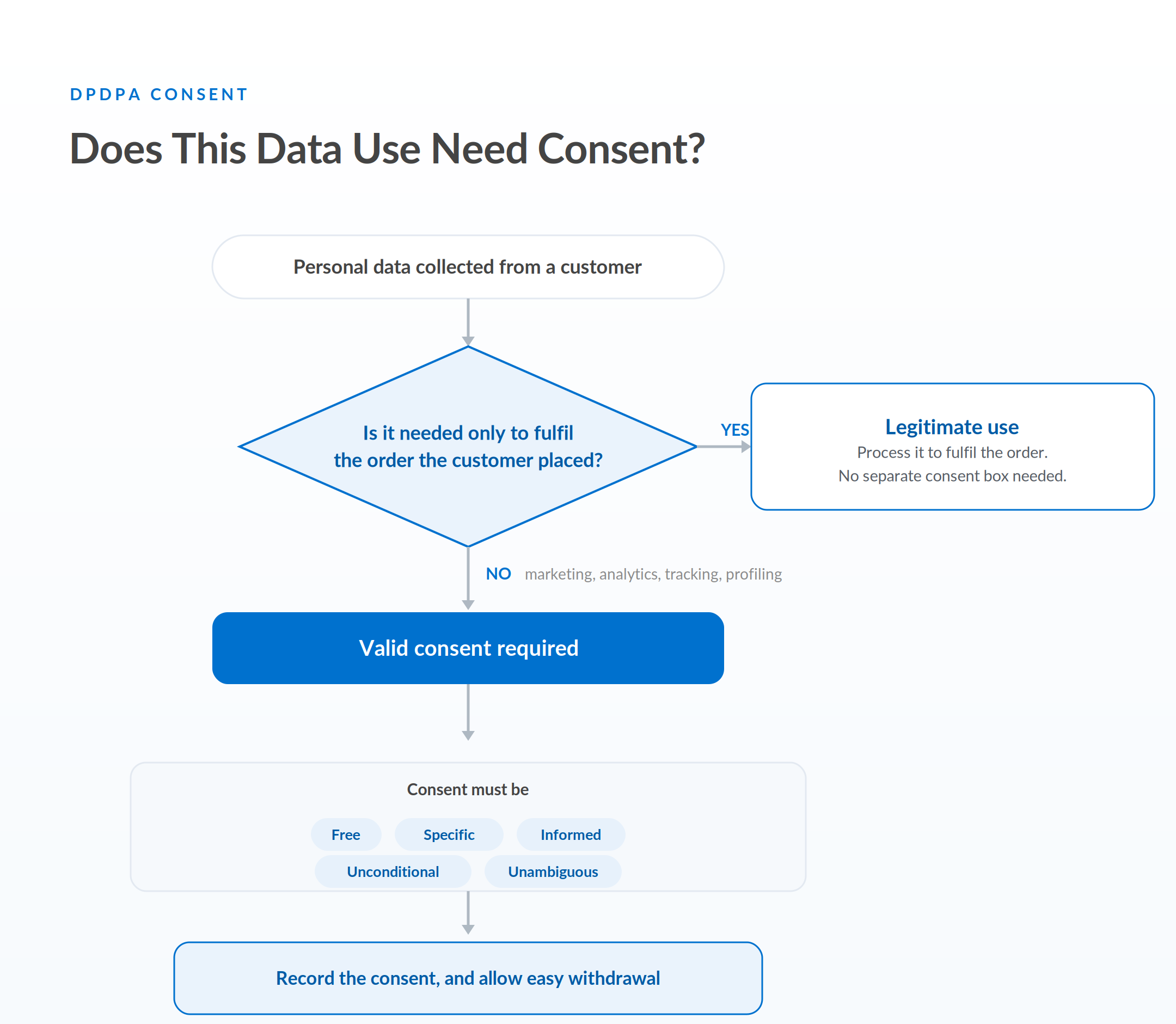
- You do not need separate consent to fulfil an order a customer voluntarily placed, but you do need it for marketing, analytics, tracking, and profiling.
- The burden of proof sits with you: you must be able to show a notice was given and consent was obtained, which makes consent records essential.
What Does DPDPA Require for Consent to Be Valid?
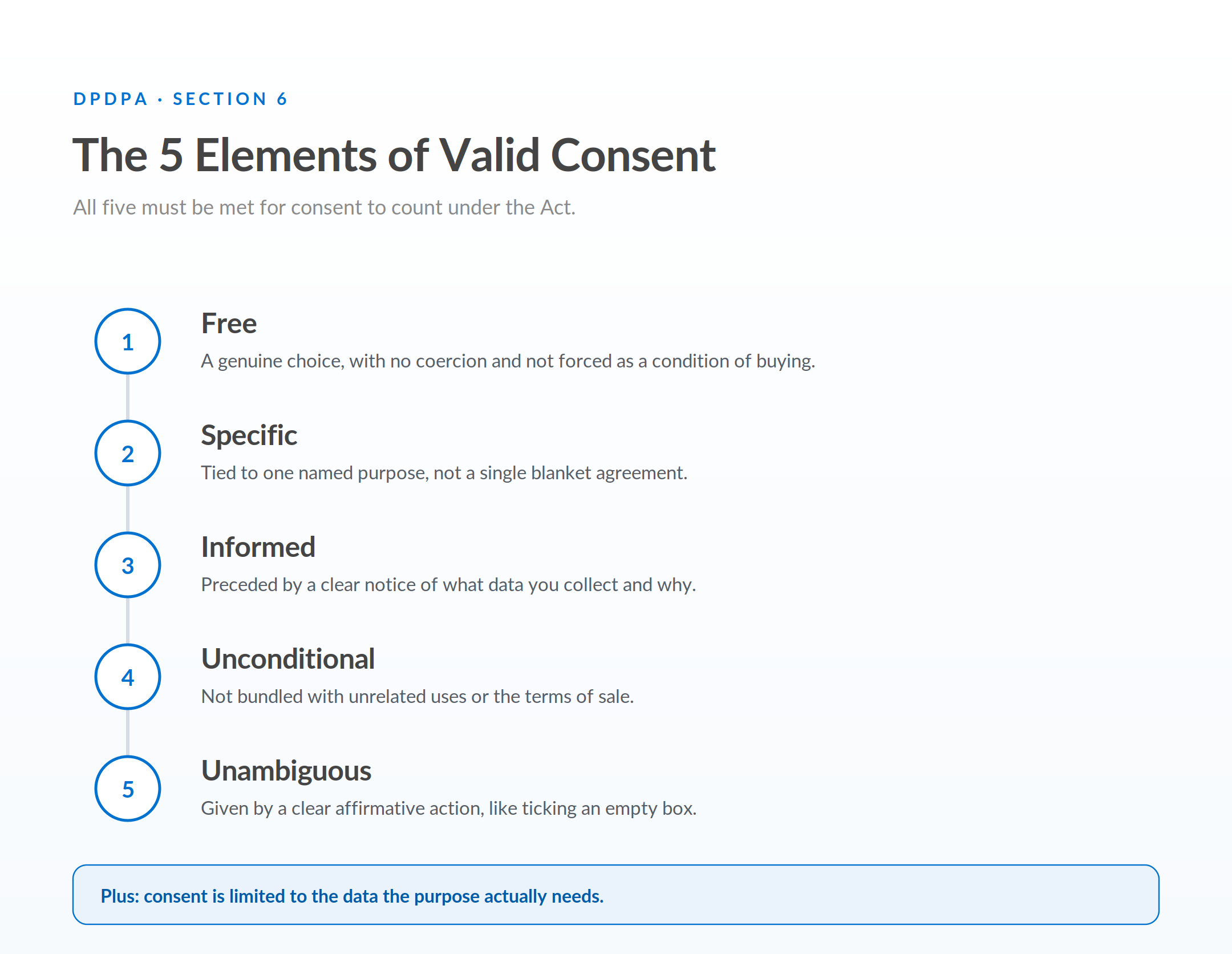
Section 6 of the DPDP Act requires that consent be free, specific, informed, unconditional, and unambiguous, given through a clear affirmative action, and limited to only the personal data necessary for the stated purpose. All of those conditions have to be met together. Consent that satisfies most of them but fails one is not valid consent. You can read the exact wording in the text of the DPDP Act on the government’s site.
Consent also cannot stand on its own. The Act requires that every request for consent be preceded or accompanied by a notice telling the person what personal data you will process and why, how they can exercise their rights, how they can withdraw consent, and how they can complain to the Data Protection Board. That notice has to be in clear, plain language, with the option to read it in English or another language listed in the Constitution’s Eighth Schedule.
The stakes are real. Breaches of the Act can draw penalties running up to 250 crore rupees, which is reason enough to treat consent as a system to build rather than a checkbox to tick.
The Elements of Valid Consent, Explained
Each word in the Section 6 standard carries weight. Here is what the five core elements mean in practice:
- Free. The person must have a genuine choice, with no coercion or pressure. You cannot make consent to non-essential processing a condition of completing a purchase.
- Specific. Consent must be tied to a precise, named purpose. One blanket agreement covering marketing, analytics, and profiling all at once is not specific enough. Each purpose needs its own consent.
- Informed. The person must know what they are agreeing to before they agree, which is why the notice describing the data and purpose is mandatory.
- Unconditional. You cannot bundle consent for the core service with agreement to unrelated uses. Consent for one thing must not be conditioned on accepting another.
- Unambiguous, through a clear affirmative action. Consent must come from a deliberate act, such as ticking an empty box or clicking an explicit agree button. Anything passive does not qualify.
On top of these, consent is limited to the data actually necessary for the purpose. If you only need an email address to send a receipt, you cannot use that moment to harvest consent for unrelated marketing profiling.
What Does Not Count as Consent Under DPDPA?
Plenty of common ecommerce patterns look like consent but fail the Act’s test. Treat all of the following as invalid:
- Pre-ticked checkboxes. A box that is already checked is not a clear affirmative action. The customer has to tick it themselves.
- Bundled consent. Wrapping marketing consent into the terms of sale, so that placing an order automatically opts the customer into promotional emails, is not unconditional or specific.
- Consent as a condition of service. Refusing to complete a sale unless the customer agrees to data uses that are not necessary for that sale removes the “free” element.
- Silence or implied consent. Assuming consent because someone did not opt out, kept browsing, or did not object is not valid.
- Vague or jargon-heavy notices. If the notice is unclear about what data is collected and why, the resulting consent is not informed.
- No way to withdraw. If withdrawing consent is harder than giving it, or is not possible at all, your consent mechanism does not meet the standard.
Do You Even Need Consent for a WooCommerce Order?
Not for everything, and this is where many stores over-complicate things. The Act recognises certain legitimate uses that do not require a separate consent step. When a customer voluntarily provides their details to place and pay for an order, you may process that data for the purpose of fulfilling the order without a dedicated consent checkbox, because the customer supplied it for exactly that purpose.
Where consent becomes mandatory is everything beyond that transaction. Sending marketing emails or SMS, running analytics and advertising trackers, building customer profiles, and sharing data with third parties for their own purposes all require valid, separately obtained consent. So the practical rule for a WooCommerce store is to keep order processing separate from everything else, and to ask for explicit consent only where the law actually requires it.
One more detail worth knowing: if a customer later withdraws consent, you must stop the relevant processing within a reasonable time, but you can still complete an order they already placed and paid for. Withdrawal applies going forward; it does not unwind a transaction already in motion.
How to Implement Valid DPDPA Consent in WooCommerce
WooCommerce in its default state was not built for this regime, so making it compliant takes deliberate configuration and, in most cases, custom development. Here is what a DPDPA-ready consent setup involves:
- Use granular, unticked consent checkboxes. Add separate, empty checkboxes at registration and checkout for each non-essential purpose, such as email marketing and SMS updates. Keep them distinct from the order itself, and never pre-tick them.
- Show a clear notice at the point of consent. Present a plain-language notice describing the data you collect and why, with a link to your privacy policy and the option to read it in a local language. State how customers can exercise their rights and withdraw.
- Gate non-essential cookies and scripts. Hold analytics, advertising pixels, and other tracking scripts until the customer consents through a banner, and make declining as easy as accepting. Essential scripts that run the store are fine; tracking is not.
- Keep consent records. Log what each customer consented to, when, which version of the notice they saw, and how they gave it. Because the burden of proof is on you, version-controlled, purpose-linked records are what protect you if a consent is ever questioned.
- Make withdrawal easy. Give customers a preference center or account setting, plus working unsubscribe links, to withdraw any consent as easily as they gave it. When they do, stop that processing.
- Enable data-principal rights and grievance handling. Provide a clear path for customers to request access, correction, and erasure of their data, and publish a contact for questions and grievances. WooCommerce and WordPress include personal-data export and erasure tools you can build on.
- Handle children’s data carefully. If you knowingly serve users under eighteen, obtain verifiable parental consent, and never run behavioural tracking or targeted advertising directed at children.
- Minimize and delete data. Collect only what each purpose needs, and erase personal data once the purpose is served or consent is withdrawn, unless another law requires you to keep it.
Because these obligations touch your theme, checkout, cookie handling, and data storage all at once, they are rarely solved by a single plugin. For a fuller picture of the changes involved, our overview of how the DPDPA reshapes WooCommerce stores maps the compliance work end to end.
Frequently Asked Questions
Are pre-ticked consent boxes allowed under DPDPA? No. Consent must come from a clear affirmative action, which means the customer has to actively tick an empty box or click an explicit agreement. A box that is already checked, or consent implied from silence, does not meet the standard.
Do I need consent to process a WooCommerce order? Not to fulfil the order itself. When a customer voluntarily provides their details to buy and receive a product, that counts as a legitimate use for the purpose of the sale. You do need separate consent for marketing, analytics, tracking, profiling, and sharing data beyond that purpose.
Does DPDPA apply to my store if I am based outside India? Yes. The Act applies to processing the personal data of people in India when you offer goods or services to them, regardless of where your business or servers are located. Selling to Indian customers brings your store within its scope.
Can customers withdraw consent, and what happens when they do? Yes, and withdrawing must be as easy as giving consent. Once a customer withdraws, you must stop the relevant processing within a reasonable time. Anything already lawfully processed before withdrawal stays valid, and an order already placed and paid for can still be completed.
How long do I need to keep consent records? Keep them for as long as you rely on that consent to process data. Because you carry the burden of proving that valid consent was obtained, your records should be version-linked to the notice shown and preserved as evidence rather than overwritten each time your policy changes.
Is a privacy policy the same as consent under DPDPA? No. A privacy policy or notice tells people how you handle their data, but publishing one is not the same as obtaining consent. Consent is a separate, active agreement to a specific purpose, given through a clear affirmative action. You need both: a clear notice and a genuine opt-in.
Does DPDPA require a cookie consent banner? For cookies and scripts that process personal data for non-essential purposes, such as analytics, advertising, or behavioural tracking, you need consent before they run. In practice that means a banner that lets people decline as easily as they can accept. Strictly necessary cookies that keep the store working do not need consent.
What happens to consent I collected before the law took effect? For data you were already processing on the basis of earlier consent, the Act requires you to send the person a fresh notice as soon as it is reasonably practicable, describing the data, the purpose, and how to exercise their rights. You may keep processing until they withdraw that consent.
What are the penalties for getting consent wrong? Invalid consent removes your lawful basis for processing, which can make the data unusable and expose you to enforcement. Financial penalties under the Act can reach up to 250 crore rupees for the most serious failures, so consent is worth building correctly from the start.
Building Consent Into Your Store the Right Way
Valid consent under DPDPA is not a checkbox, it is a system: free, specific, informed, unconditional, and unambiguous agreement, backed by clear notices, easy withdrawal, and solid records. Scope it correctly, so you rely on legitimate use where the law allows and ask for consent only where it is genuinely required, and the work becomes far more manageable than it first appears.
This article is general information, not legal advice. Your exact obligations depend on your business, your data, and how the Act and its rules apply to your situation, so confirm your approach with a qualified data protection professional. If you need custom WooCommerce integrations to make your store DPDPA-ready, from consent flows and records to data-rights tooling, contact us about a custom DPDPA integration and we will map and build the implementation for your setup.
Author: Neha Jain
Neha Jain is a software engineer focused on payments and API-driven integrations, including webhooks, authentication, error handling, and secure deployment patterns. Her work emphasizes production-ready implementations, with attention to vendor specifications, common failure modes, and integration reliability. She brings a practical approach to system design, balancing performance, security, and maintainability. Neha’s focus is on helping teams implement complex technical workflows with clarity and fewer regressions.
Related Posts
- Top 5 SEO Audit Apps for 2026 (And Why Local Crawlers are Winning)
- Top 10 WordPress Plugins to Supercharge Your WooCommerce Store
- How to Migrate From WooCommerce to Shopify: A Step-by-Step Guide
- Algolia vs Elasticsearch vs Meilisearch for Ecommerce Search
- Shopify vs WooCommerce for Small Businesses: Which Costs Less to Run?
- How DPDPA Will Impact WooCommerce Stores in India
